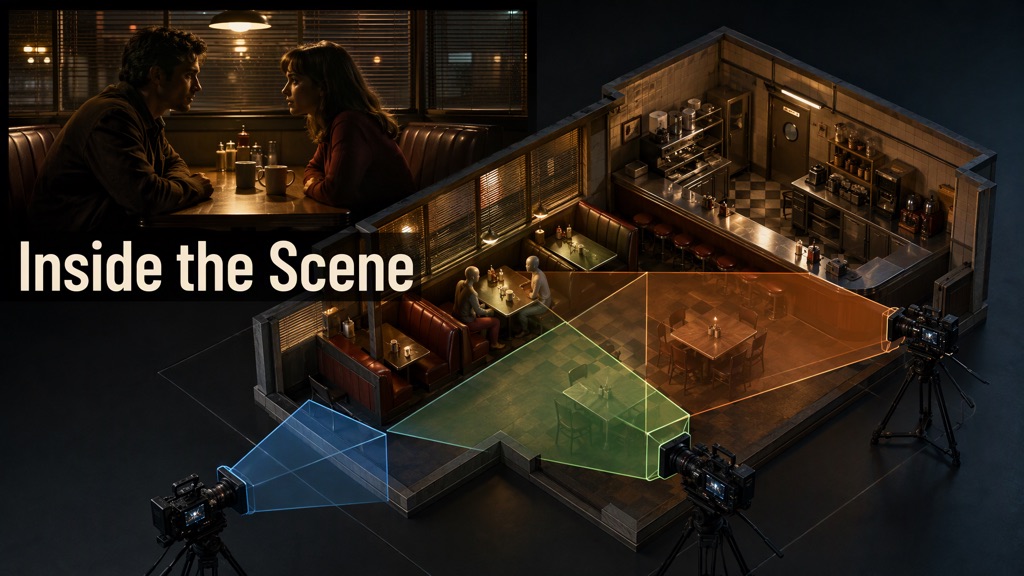
Input: Actual film/reference video or obtainable link; range/priorities (cameras, blocking, space, lighting), plus available plans, production records and dimensions.
Output: Interactive HTML, same-data synchronized video, editable Blender project and analysis data. Show source, current shot, animated set, shot list and dialogue together; representative source/model comparisons.
Explain finished footage for film study, teaching/research. “Blender Previs” designs filming from scripts/new storyboards; connect them if useful, verifying each task's outputs.
Execution assets
Purpose: Present analyzed shots/set/times as consistent HTML and export synchronized video. Templates, validation/packaging scripts do not replace footage analysis, modeling or camera calibration. Use after analysis in step 6; inspect actual page/export in step 7.
Download package · 20261105.1 · 247,835 bytes
SHA-256: 7b23efc304ee4a6c57ef7036486ab1c7e696712657992ed1518a4c6951567144
Download, verify size/hash, extract into project; reuse an identically verified version. Root 3d-film-set-report/ is the directory meant by assets/, scripts/ and inspiration-directory placeholders. Preserve structure; use bundled scripts, not older namesakes. No user video/results included.
Requires Python 3, FFprobe, esbuild. Read validator/page modules for fields; follow build_report.py --help with analysis JSON, clipped MP4 and frames. System fonts. No Blender project: model/calibrate below.
Tools and roles
- Analysis: Verification, viewing, segmentation, elements, cross-shot/editing/sound methods are included. Execute directly; no prerequisite inspiration retrieval.
- Host Agent: Available multimodal understanding, evidence, space/camera reasoning, scripts and inspection.
- Blender: Space, simplified people/props, cameras/frustums/lights; render/save. Reuse verified CLI/MCP. Background scripts suit headless/batch tasks; GUI community MCP suits continuous adjustment. Both require minimal tests; desktop-control failure does not prove Blender unavailable.
- FFmpeg / FFprobe: Host media probing, frames, rendering/compositing and synchronization checks.
- Flova (optional): Only for applying findings to new work/practice; source analysis/blockout comparison use tools above.
Blender access
CLI or community MCP for Blender, chosen for task/environment. CLI need not fail before MCP.
- CLI: Headless Python/batch render; explicitly load/change/save checkpoints.
- MCP: Execution machine needs installed/running Blender, enabled add-on and connection. Usually user's machine; Agent needs connection/file access. Installing server ≠ Blender. Current add-on requires GUI event loop, not
blender -b; verify repository setup. - Inspection: Scene/Python access, multiple views, wireframes, animation strips support camera/occlusion/position checks, not replace spatial reasoning. Save
.blendeach revision. - Failure: Read execution errors/body/state, not only
isError. After timeout check actual scene/output changes before retry. After exit restore Blender/saved project, then reconnect.
Analysis knowledge
Find continuous image/sound changes and how they jointly guide attention. Concepts prescribe no film-specific conclusion.
Viewing and evidence
Watch the whole range for structure, action, information and sound/image relationships; revisit cuts/events. Stills support composition; movement, transitions, focus and sound require continuity. Add start/end/hold/change frames, varying density with speed/uncertainty.
Keep timed shots/elements, stable cross-shot IDs for people/scenes/props/landmarks, timestamp changes, actual frame/replay references. Visible, identified and extracted are distinct states. State unclear/uninspected limits.
Camera movement: what moves?
Compare static background, subject scale, occlusion/perspective to separate people, camera translation/elevation, pan, zoom, reframe and cut.
- Moving people with stable background do not establish camera motion.
- Pan changes direction; translation viewpoint, often parallax/occlusion. Rig type needs extra evidence.
- Push-in/zoom both enlarge subjects: check parallax/perspective/occlusion; tightening alone proves no push-in. Consider digital crop.
- Record start/end, timing, target/holds. Static is valid; invent no motion.
Does camera anticipate, follow or wait until someone leaves? When does information appear/disappear?
Angle and shot size
Separate front/side/back from eye-level/high/low relative to subject eyeline. Elevated camera ≠ high angle: posture, terrain, optical axis matter.
Record size, frame position, eyeline, foreground occlusion/offscreen space. Verify over-shoulders/two-shots/reactions with neighbors, positions/axis. No fixed “low=power/close=tension”: performance, duration, sound/context determine effect.
Lens, gate and distance
Focal length, effective gate/crop determine view; distance also subject size. Viewpoint primarily determines perspective, not “telephoto compression” alone. Use view, subject/background scale and occlusion for lens/distance candidates. Model millimeters are gate-dependent fits: record sensorWidth/crop assumptions. Unsupported values remain range/view/unknown, not production equipment facts.
Depth, aperture and focus
Describe sharp/soft planes, shifts and action/dialogue timing. Blur may be motion, occlusion or post, not missed focus.
- Depth depends on aperture, lens, distance, viewing criterion/gate; shallow depth cannot uniquely yield f-number.
- Aperture unknown without credible records/metadata; demo f-values labeled.
- Focus subject ≠ known distance; record each/evidence separately.
- A rack focus may sequence attention; fixed focus may leave moving foreground occluding. Require continuous evidence for shifts.
- A “focus subject” label ≠ simulated depth. Configure optics/compare separately.
Dialogue and sound
Time speech, calls, responses, pauses/cut-driving sounds. Separate speaker, on/offscreen, text/language and basis. Transcript/subtitle clues ≠ verified listening; unchecked ≠ no dialogue.
Check sounds preceding/bridging cuts; shots of listeners, discussed people/actions. Explain reactions through these relationships, not paraphrase alone. Unknown speaker stays unknown; editing position proves no attribution.
Blocking
Establish shared space with landmarks; record positions, body heading, eyeline, paths, distances/occlusion at actual events, not fixed intervals. Separate observed/offscreen inferred paths.
Screen-right ≠ world-right; reverses/pans/orbits alter direction. Map to 3D only after coordinates. Check speech-triggered pointing/turn/approach/departure, camera angle/size response, focus on speaker/listener/target. Test explanations in 3D; invent no invisible action.
Motion: calibrate the whole interval
People/camera motion is central. Prioritize travel, holds, turns and camera relationships before appearance/presentation. Matched endpoints do not validate the middle.
- Separate camera/people: Constrain camera by static-background parallax/perspective/occlusion, then people in that space. Pan/tilt changes axis, translation viewpoint; zoom/crop separate. Do not move both arbitrarily to cancel errors or derive world paths solely from screen displacement. Tracking reflects people/camera/error: projection clues only. Never convert head-tracking jitter into torso/joint animation.
- Per-shot initial state: A candidate group can contain position/angle/lens/framing variants. Verify each; don't blindly reuse its representative pose.
- Actual-change nodes: Onset, acceleration/deceleration, hold, turn, occlusion, reappearance/end with framing/person states. One linear segment only if intermediate frames support constant-speed straight motion; otherwise nodes/curves. Check rotation direction/wrapping; no unsupported spins/jumps.
- Separate person states: Ground position, body/head/eyeline, standing/sitting/leaning. Check prop avoidance, occlusion order, turn timing. Rigid translation is enough; gait only when needed, then inspect foot placement/sliding. Recording states doesn't require animating each. Height-scaled/posture shortcuts are demo proxies, not reconstructed actions.
- Unknowns: Occluded/offscreen routes admit alternatives. Known endpoints permit candidate connections, not observed middle paths. Unresolved translation/zoom/focus retain alternatives/evidence; calibrate confirmed changes. Tracking/occlusion/texture gaps are unknown, not static cameras/people.
- Presentation versus source camera: Overhead orbit/pan/zoom presents the set; source motion reads candidate-camera data. Presentation cannot substitute for calibration.
Compare same source times at start/middle/end and actual key changes via matching-camera renders/reprojection. Check landmarks, subject position/size, heading, occlusion, starts/stops/holds and relative camera/person motion. Recheck other shots/unfitted times: lower fit residual ≠ independent validation. Center alone is insufficient; verify front/back occlusion, cameras outside walls/furniture, stable person dimensions/limb proportions.
One five-way judgment
Record movement, angle, depth/focus, dialogue, blocking; then when whose voice/action changes attention, camera/focus response and adjacent-shot information. Relations occur within/across shots. Without continuity say possible/unknown, not confirmed intention. Check repetition/change/exceptions across range.
Editing and overall interpretation
Compare action phases, eyelines, positions, prop states, directions/sound across cuts. Who receives attention? Omitted action, prolonged waiting, reaction? Record visible cut/occlusion/dissolve; intra-shot changes are events.
Group recurring subjects/spaces/views/compositions with evidence, invariants, variants/alternation. Appearance alone proves neither same setup nor continuous filming. Recheck people/scene/props each time.
Support overall claims by durations/repetition/holds/cuts/sound. Analyze relevant music/effects/color/subtitles with measurements/observations. Reuse advice states transferable relations/redesign conditions, not source facts.
Evidence in data
- Observation: time/frame/continuous range.
- Listening/transcript/subtitle: source/human verification.
- Records: traceable source/applicable production version.
- Inference: clues/alternatives.
- Model/demo: fitting conditions/purpose.
- Unknown: null/text, not model defaults.
Retain evidence in data/details; main page prioritizes film information, not repeated long explanations.
Workflow
0. Environment/minimal test
Before batches, save scripts/commands/versions/exits/logs. Test actual Blender execution environment, not assumed user-computer access.
-
Follow ; verify entry/version, FFmpeg/FFprobe. CLI
--version, paths if outside PATH:/Applications/Blender.app/Contents/MacOS/Blender. MCP: connection/GUI/readable scene. Missing host CLI doesn't invalidate working MCP. Report gaps; partially deliver below. -
Separate test directory:
scripts/00_preflight.py, primitives/camera/low-resolution, save.blend, reopen/access expected objects, render PNG. Run same task via chosen CLI/MCP, separate from production. Replace<BLENDER>:"<BLENDER>" --background --factory-startup --disable-autoexec --python-exit-code 1 --python scripts/00_preflight.py -
Finite startup/frame timeouts, e.g. 30/120s, adjustable. Verify CLI exit/MCP body, completion marker, nonempty
.blend, decodable image; inspect image. Version/empty-file/tool success alone fails. -
Proceed after pass; retain script. CLI loads prior project; MCP may adjust continuously. Both use named objects/save checkpoints/resume saved projects. No GUI-dependent background operations. Renderer failure: log-based compatible settings, test one frame.
Blockers/retries
Log stage/call/arguments/exit/timeout/error/files and next correction/hypothesis. No unchanged launch loops. Two consecutive attempts at same blocker without new evidence/output: stop route; changed commands/entrypoints or “continue” aren't progress. Only applicable alternatives independent of fault, minimally tested. Otherwise deliver existing shots/sketches/blockout as partial, errors/attempts/recovery conditions. Missing video/.blend stays unfinished; source/keyframes/diagrams aren't substitutes. No promised post-execution automatic continuation.
1. Media/scope
Obtain actual footage, preserve requested scope/priorities; record source/link/version/acquisition time/range. Preserve original, process copies. Verify linked object/version; use available authorized acquisition. Disclose restrictions; covers/descriptions aren't footage. Observation failures don't warrant redownloading existing files.
Verify playback/duration/resolution/aspect/fps-timestamps/audio; define source/clip mapping. Record picture/audio/subtitle inspection separately, unclear/missing/unverified = unknown. Illustrations permit hypotheses, not claimed shot analysis. Prefer continuous space/complementary directions/recurring landmarks. Test informative subsection before full range; 30–60s/~5–10 shots is an initial trial, not scope limit.
2. Shots/candidate groups
Apply all : full continuous viewing then detail; frames locate, playback verifies motion/transitions; sound/subtitle/listening/transcript status separate. Actual cuts define IDs/start/end/duration/title/frame. Exclude flash/motion/occlusion false cuts; intra-shot changes are events, narrative spans use separate IDs. Save full frames/replay times; vary density with speed/uncertainty, including motion/action starts/changes/holds/ends. Unobtained images aren't saved/embedded evidence.
Per shot: five dimensions/relationship, source-timed observed events and motion nodes (time/landmarks/person position-heading-posture/camera position-axis-view/evidence/unknowns). Observe before fitting. Events drive explanation/people/cameras; never fixed-interval invention.
Stable relevant-element IDs, two-way shot links, timed appearance/action/location/prop changes; unknown identity/brand/hidden structure; identified ≠ acquired. S01 shots/C01 candidate groups: supporting frames/landmarks/direction/view, grouping evidence/invariants/variants/alternation. Background similarity needs perspective/occlusion/motion checks; group count ≠ physical cameras.
Test overall claims against durations/order/reactions/holds/sound. Expand only relevant light/color/text/music/effects; precise BPM/equipment/software needs measurement. Future filming/adaptation = suggestions.
3. Space/scale
Plan doors/windows/corners/stage/furniture/action/props. Relative scale first; supported dimensions/heights, labeled estimates. Multiple views constrain direction/height/view. Lens sensor/distance/crop uncertainty → range/view, no false precision. Supported person states only; offscreen links inferred. Separate lens/aperture/focus; gate/crop/model conditions, focus subject/distance. Sharp-plane changes ≠ known aperture/distance; unknown empty, model inferred, records sourced.
4. Shared set/reprojection
One primitive set with identifiable stand-ins/props/cameras; stable shot IDs map to cameras/time. Space/camera/blocking before detail. Reproject structural wireframes from representative directions; check door/window edges/perspective/occlusion/proportions, render same-camera blockout beside source. Revise/recheck other views; retain ≥1 issue/change/result cycle.
Apply full motion calibration above at matching times, not one frame. Match supports hypothesis, not true filming values. Persistent mismatch: revisit space/motion/distortion/post crop/set changes; retain alternatives, not incompatible per-shot spaces.
5. Blocking/lighting
Fixed-size/proportion stand-ins, timed ground path/start-stop/body heading; stable shape. No default gait/arm swing/nod/sway/acting or mandatory likeness/clothes. Few stand/sit/crouch presets only for composition/occlusion/eyeline height; head turns/point/reach only with continuous evidence affecting eyelines/occlusion/framing/camera response. Invisible action unknown/hypothetical.
Observation nodes constrain travel/turn/posture/path/speed. Shared coordinates/time, cross-shot states preserve edited-out time, not forced continuity. If linear/height proxies cannot express key changes, extend animation/disclose coverage, don't fake motion. Lighting from sources/shadows/sides/rims: lamps/windows/flags/background as needed; separate visible/inferred/demo. Model count ≠ real lights; unsupported power/temperature empty.
6. Page/video
Use , actual data for validate_analysis.py: shots/cameras/people/motion/dialogue, MP4 zero=range start, shot frames/optional same-view renders. From extracted root, task paths; omit --models without images, pass --esbuild outside PATH:
python3 scripts/validate_analysis.py <analysis.json>
python3 scripts/build_report.py --data <analysis.json> --video <clip.mp4> --frames <frames-directory> --models <model-images-directory> --output <report.html>
Open/check page, use “Export video”; WebM→MP4 via FFmpeg when required, then inspect. Page/button ≠ video. Follow , one dataset/playhead, five visible panels:
- Source: Aspect/audio/timecode/current-shot/timeline.
- Shot: Size/move/angle/depth/lens/aperture/focus/dialogue/blocking/relationship.
- Set: People/active-camera/frustum/paths, event-synced overhead 3D/plan/camera.
- Shots: Frame/ID/time/setup, seek/follow.
- Dialogue: Speaker/time/text/needed original, seek/follow; pending if unverified.
No irrelevant process prose/setup-group main panel; evidence/full analysis/model conditions in details/data, groups only set index. Same-data/model/time 9:16, default 1080×1920, optional 720×1280, reflow/source audio/verified subtitles; disclose actual container/resolution/recording limits, verify actual video.
maps assets/report/scripts. Verify media contract; examples/defaults/demo lights aren't analysis. Instructions-only environment: implement/verify structure/contracts/standards, don't claim templates loaded. Counts/parameters derive from footage.
7. Verification/delivery
Actually test package HTML play/seeks/timeline/views/dialogue/unknowns; same data/time as actual export. Watch whole video: cuts/camera highlights/motion/people/dialogue/focus sync, sound/aspect/text. FFprobe duration/resolution/container/AV tracks; no conflicting conclusions. Check ≥3 complementary views for landmarks/perspective/occlusion; disclose footage limits/scope.
Separately accept source-timed motion under calibration/completion criteria, retaining checked times/corrections. Wrong middle/intersections/relative motion → revise or label uncalibrated/partial. Playback/moving paths prove no blocking accuracy.
Reopen saved Blender: editable objects/readable dependencies/rerender shots. Deliver HTML/JSON/actual video/keyframes/project/comparisons/notes, used modeling/build/compositing scripts; facts/assumptions/unknowns/corrections. Missing media/tools/evidence → partial shots/sketches/blockout with gaps; diagrams/templates/export entry aren't completed synchronized analysis.
Data/page/export contract
Information structure
Source seconds; clip starts at 0: 源片时间 = source.start + video.currentTime. Cuts [start,end), stable IDs. VFR uses timestamps, not nominal-fps cut arithmetic. Model set.fps frame0=clip start, not constant source fps.
Per shot:
Dialogue: speaker/start-end/original/translation/on-offscreen/verification/shots; can cross cuts, no forced unknown attribution. Group IDs/shot links ≠ camera counts. Internal setups get no main panel.
Retain source/version/acquired time/inspected range. Optional element inventory: stable IDs/traits/frames/shot links/state changes/asset acquisition. Groups: evidence/invariants/variants/sequence. Overall claims cite times. Data/details, not more panels.
Unknown numeric lens/aperture/focus=null. Visible focus subjects ≠ assumed model distances; renderer defaults never fill source facts.
Main page
Five panels together, stacked on small screens. Brief observations/relationship cards, expandable detail; unknown parameters/inferred labels retained, no process clutter.
One time for source/timeline/card/cameras/people/events/dialogue. Shot/dialogue seek, lists follow. Overview/plan/camera share scene; presentation orbit changes no candidate camera. Unmodeled shots retain analysis/source, no invented camera; missing comparison disables entry.
Video
Same data/model/time, 9:16, default 1080×1920, optional 720×1280. Reflow, preserve source aspect/audio/verified subtitles; shot/set/index synchronized. Limited current-neighbor thumbnails, not all squeezed off-canvas.
Browser real-time export needs visible page; codec determines actual format, MP4 preferred else honest WebM. FFmpeg transcode, not rename. Long/background/exact constant-fps jobs: frame rendering+FFmpeg, separately verify.
Completion criteria
- Full requested coverage, real cuts/events inside shots.
- Actual play/seek/views; correct unknown/unmodeled display.
- Actual export fully checked: AV/dialogue/aspect/text/set.
- Saved project reopened/rerendered; comparisons match camera/time.
- Motion start/middle/end/key changes checked; person/camera paths/headings/occlusion/rhythm separately, uncalibrated labeled.
- Separate done/unverified sound/model assumptions/unknowns. Valid data ≠ correct interpretation; HTML ≠ accepted video/Blender.
Template guide
Five-panel implementation; methods in . No film analysis/media/Blender project.
Files/execution
assets/report/workbench.html,.css,.js: page.assets/report/set3d.js,plan2d.js,data-view.js: shared set/data.assets/report/video-export.js: vertical recording.assets/report/vendor: Three.js/licenses, retain on distribution; system fonts, no font files.scripts/validate_analysis.py: time coverage/IDs/mapping/fields/animation, not interpretation correctness.scripts/build_report.py: validate/single-file HTML. Python3/FFprobe/esbuild, no auto-install. Verified esbuild 0.25.12; executable selectable.
Actual JSON/clipped MP4 with source audio, per-shot {id}.jpg, optional same-view renders in models directory. MP4 zero=source.start; normalize rotation/pixel aspect. Task paths:
python3 scripts/validate_analysis.py /path/to/analysis.json
python3 scripts/build_report.py \
  --data /path/to/analysis.json \
  --video /path/to/clip.mp4 \
  --frames /path/to/frames \
  --models /path/to/models \
  --esbuild /path/to/esbuild \
  --output /path/to/report.html
--models optional. Build probes dimensions/duration/audio, embeds media/styles/scripts; system fonts. Large files: choose quality for duration. Test target host; local HTTP verified, direct file opening needs testing.
Input contract
Additional analysis allowed, defaults don't replace observations.
Z up; yaw0=+Y, positive toward +X; pitch positive up. Pose lens=model parameter; displayed photography independently reads photography; explain differences in data. basis: confirmed/model/infer/demo/unknown; records sourced, model/demo conditions stated. Focus meters consistent with scale.
Scope
One-scene blockout, linear person travel, camera movement/rotation/aim. No automatic video geometry, rack-focus/aperture/complex acting/real lighting simulation. Events can describe them; model display needs extended calibrated animation/rendering. Default lights aid spatial legibility.
Multiple scenes: separate reports or extend scene-specific model/camera loading first; never reuse one space and claim all reconstructed.
Native MP4 preferred, browsers may give WebM; keep page visible. Download/inspect media, not completion messages. Cache/thumbnail limits exist; long clips still require memory, real-time performance/AV sync tests.