
Key takeaways
- Compare the same deliverable: generated footage, edited stock-based video, and avatar-led training video are different products.
- Video APIs charge by generated second, credit, token, reference input, or a combination of these units.
- Credits follow each platform’s conversion table. Track export minutes and newly generated footage as separate quantities.
- Budget for usable footage, reference inputs, creative revisions, and editing time.
- Compare annual and monthly subscription totals alongside included credits and the quantity of accepted output produced.
- OpenAI’s Sora 2 API shut down on September 24, 2026. Google lists an October 22, 2026 shutdown for specific Veo 3.1 Preview endpoints.
The shutdown dates above identify the named OpenAI and Google first-party endpoints.
AI video market size and creator-economy spending
AI video production sits within three economic layers: video-creation software, creator-led advertising, and creator earnings across platforms.
Grand View Research projects a 20.3% CAGR for the AI video generator market over 2026–2033. Its research draws on company documents, interviews, and databases.
Goldman Sachs’ April 2023 analysis valued the creator-economy opportunity at approximately USD 250 billion and projected USD 480 billion by 2027.
Grand View Research estimates the global AI video generator market at USD 946.4 million in 2026.
Actual commercial scale: creator advertising and platform revenue
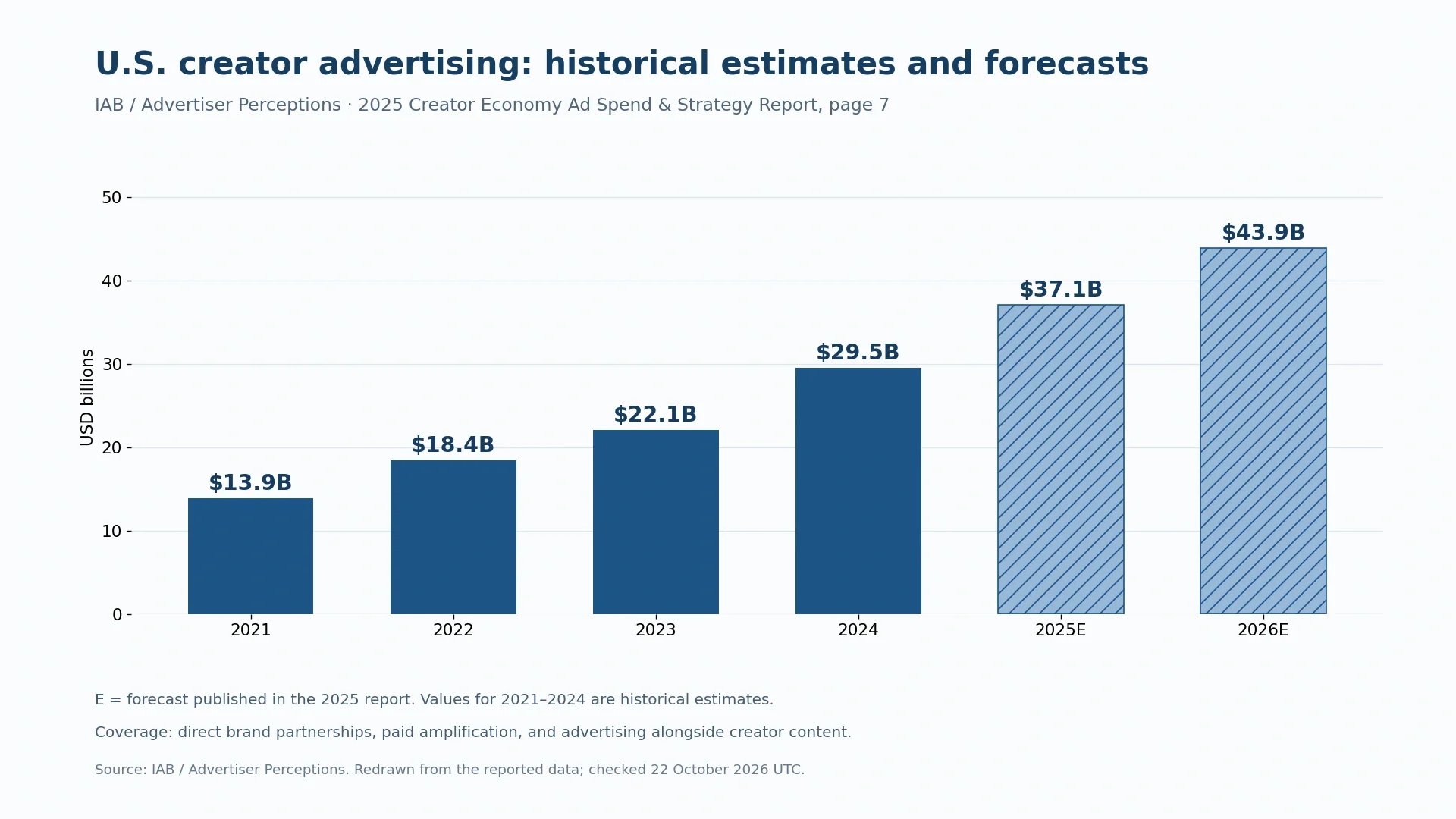
IAB’s 2025 report charts U.S. creator-economy advertising spending at USD 13.9 billion in 2021 and USD 29.5 billion in 2024, with projections of USD 37.1 billion for 2025 and USD 43.9 billion for 2026. What's more, 85% of consumers say they've been convinced to buy a product or service after watching a video.
IAB and Advertiser Perceptions cover direct brand–creator partnerships, paid amplification, and advertising placed alongside creator content. The methodology combines financial analysis with a survey of 453 U.S. advertising decision-makers, fielded July 28–August 12, 2025. Respondents planned at least USD 1 million in total advertising and USD 100,000 in creator marketing that year.
Kuaishou’s second-quarter and interim 2026 unaudited results report more than RMB 850 million in Kling AI revenue in Q2 2026, with year-over-year growth exceeding 200%.
In its January 2026 CEO letter, YouTube reported paying over USD 100 billion to creators, artists, and media companies over the preceding four years.
AI creator adoption and platform usage
Adobe’s creator surveys and YouTube’s platform disclosures show how creative AI is being adopted by individual creators and active channels.
Adobe’s 2025 survey focused on emerging and semi-professional social creators who published digital content at least a few times a month. Its 2026 survey covered income-generating emerging and professional social-first creators. Both covered the U.S., U.K., France, Germany, South Korea, Japan, India, and Australia.
Goldman Sachs’ April 2023 analysis estimated approximately 50 million creators worldwide. Adobe’s 2025 survey found that 60% of creators used more than one creative generative AI tool in the preceding three months.
YouTube reported that more than one million channels used its AI creation tools daily on average in December 2025.
Creator survey data: production speed and editing workflows
Adobe conducted its 2026 Creators’ Toolkit survey with The Harris Poll among more than 16,000 creators in eight countries in May 2026. The report covers creators’ experiences with creative AI across media.
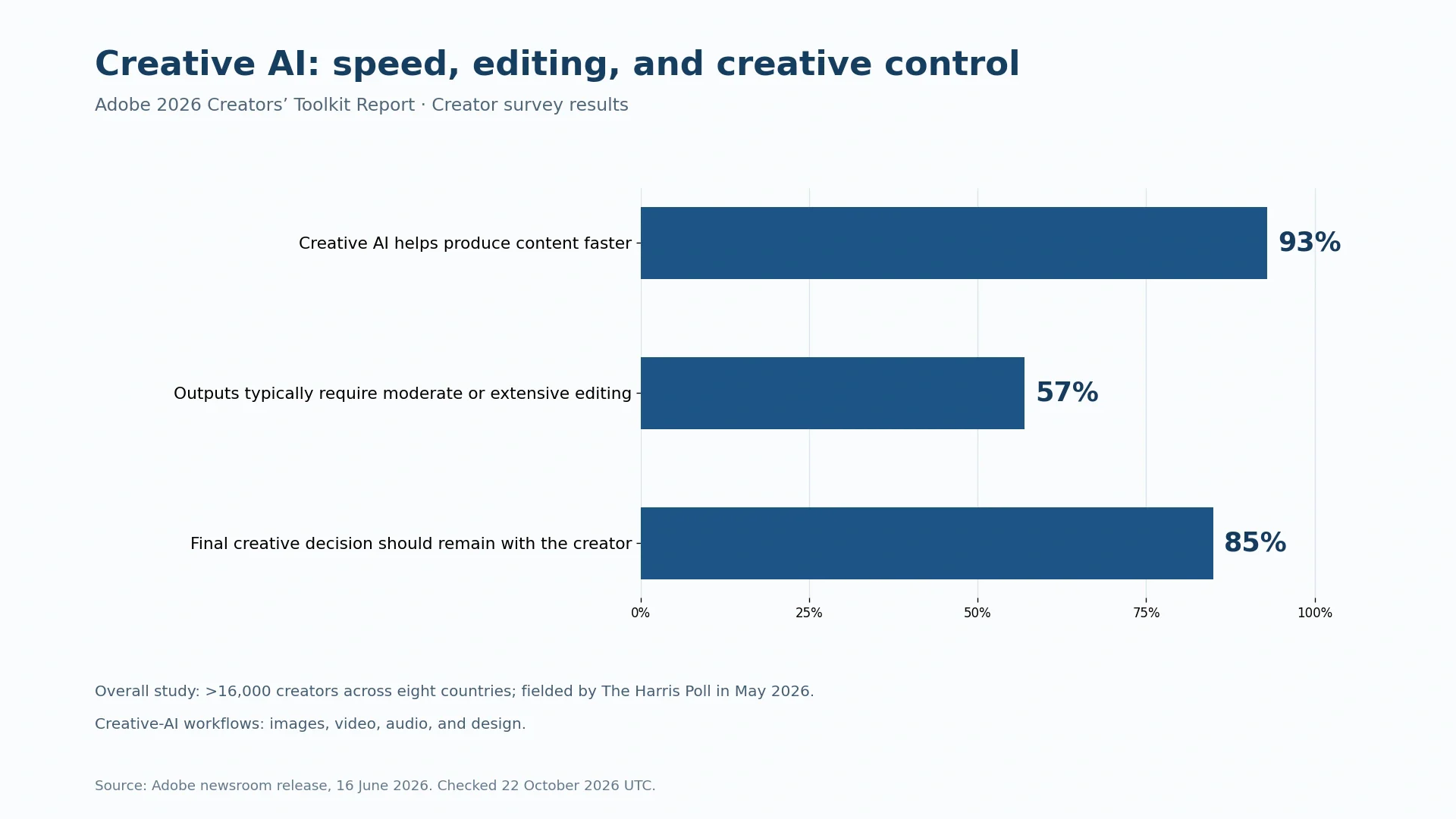
In Adobe’s 2026 survey, 57% of creators said creative-AI outputs typically needed moderate or extensive editing before sharing.
Adobe’s 2026 report found that 85% of creators believed the final creative decision should remain with the creator. For AI-use disclosure, 49% said they always or often disclosed it, while 18% said they rarely or never did.
Individual creator economics: work patterns, formats, and affordability
Patreon and NewtonX’s State of Create 2025 surveyed 1,007 creators and 2,002 fans in the United States in August 2024. The creator sample covered full-time, part-time, and hobby creators working across content formats.
Segment creator budgets by monthly accepted output, income frequency, available editing time, and subscription utilization. Patreon’s survey supplies the full-time, part-time, and hobbyist work profiles; calculate tool spending from each creator’s own production budget.
Goldman Sachs’ April 2023 analysis defined professional creators as those earning more than USD 100,000 annually and estimated that they represented about 4% of creators.
For an individual creator, monthly production expense as a share of monthly creator revenue provides a practical affordability measure. Production expense includes subscriptions, additional usage, editing, assets, and delivery.
Audience scale and advertiser adoption
YouTube’s January 2026 CEO letter reported that Shorts averaged 200 billion daily views.
IAB’s 2025 survey of 453 U.S. advertising decision-makers found that 46% were currently using AI for creator-content creation and work processes, while 29% planned to use it in the next 12 months.
Audience activity, advertiser adoption, platform revenue, and creator surveys show the commercial reach of AI-assisted content production.
Pricing models explained: what are you actually buying?
AI video tools commonly charge by generated second, clip or task, credit, export or avatar minute, and subscription. Subscription plans can include credits that are consumed at model-specific rates.
Runway’s 720p product-ad API recipe starts at 200 credits for four seconds, plus 36 credits per additional second. At $0.01 per API credit, the base charge is $2.00 plus $0.36 per additional second.
Current subscription benchmarks by major tool
The table compares published subscription offers. Annual prices are shown as monthly equivalents.
Published subscription pricing sources:
Synthesia: distinguish video from other credit uses
Synthesia provides a shared credit pool for video, dubbing, and other AI features. Starter and Pro include estimated video-minute allowances based on credits allocated to video. The free allowance is listed separately, and Enterprise includes 1-click translation into 140+ languages.
Pictory: export minutes and generative credits
Pictory defines video minutes as exported minutes. Previewing, editing, and sharing inside the account leave the export-minute balance unchanged. Professional includes 600 export minutes per month and a separate generative AI credit allowance. Annual export allowances are available upfront.
Invideo: check seats, models, and promotion terms
Invideo lists Starter at $10 per seat per month on annual billing and $20 on monthly billing, with 400 credits per seat per month. Starter excludes Seedance 2.5. For projects using that model, select a plan that includes it. These are the advertised offers recorded on the pricing-check date.
API pricing comparison for developers and high-volume workflows
Runway Dev sells API credits for $0.01 each and publishes model-specific generation and feature rates. The table converts these rates into dollar charges.
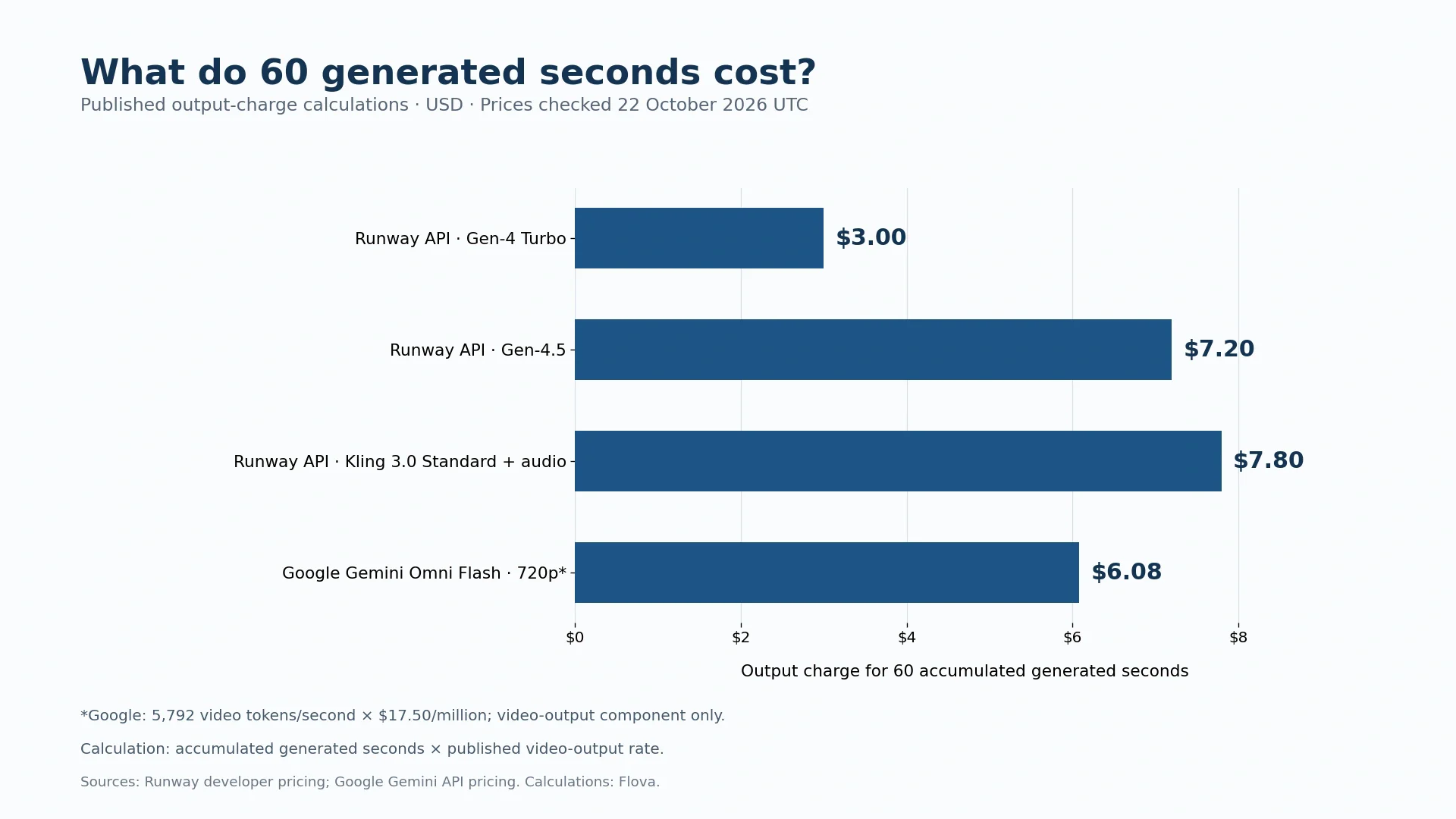
The Google figure is calculated as 5,792 ÷ 1,000,000 × $17.50. Google describes the effective 720p video-output price as approximately $0.10/second. The duration calculations below use the unrounded $0.10136/second output rate, with input charges recorded separately.
For a developer, reference media can be a material second cost axis. At Runway’s Seedance 2.5 720p rates, a permitted job with 10 seconds of output and 10 seconds of reference video would have a listed charge of (10 × 30) + (10 × 15) = 450 API credits, or $4.50, before tax and other services. Counting only the output would produce $3.00 and omit $1.50 of input-video charges.
Record the hosting route alongside the model name: first-party APIs, third-party API services, and editor subscriptions each publish their own prices, supported settings, usage limits, and commercial terms.
Veo 3.1 and Sora 2: legacy prices and availability
OpenAI’s Sora 2 models and Videos API shut down on September 24, 2026. The model page records a historical Sora 2 720p rate of $0.10/second.
Google’s pricing and video documentation list an October 22, 2026 shutdown date for veo-3.1-generate-preview, veo-3.1-fast-generate-preview, and veo-3.1-lite-generate-preview in the Gemini API. Its guidance points developers to Gemini Omni Flash or separately available GA models through the enterprise platform. Check the exact endpoint, route, and region before estimating a new production pipeline.
The legacy Veo 3.1 Fast 1080p tier was listed at $0.12/second; Standard 4K was listed at $0.60/second.
Cost per credit and credit-to-output conversion
A credit is an accounting unit defined by a vendor. Converting it into dollars is only the first step; you must then apply the correct consumption rule. For a straightforward API, cost equals credits per generated second × purchased-credit price × generated seconds. Add separately priced inputs, minimum job charges, and output formats where applicable.
Runway Gen-4.5 uses 12 developer API credits per second at $0.01 per credit, giving a five-second output charge of $0.60. Runway Standard’s $15 monthly web subscription includes 625 credits, equivalent to about 52 seconds of Gen-4.5. At full credit utilization, the allocated subscription cost is $0.024 per credit.
Calculate generation costs using the selected product’s credit conversion table, purchased-credit price, and generated duration.
Illustrative subscription allocation: a $15 plan spread across 50 accepted seconds allocates $0.30 per accepted second; spread across 25 accepted seconds, it allocates $0.60.
Cost by video length: one, two, and three minutes
The table below calculates output charges for 60, 120, and 180 accumulated generated seconds. Build longer edits from supported shot lengths and calculate generation charges from the footage created for the project.
Calculation: generated seconds × the published unit rate, rounded to cents. Runway rates use developer API pricing; Google’s rate uses its 720p token conversion.
Illustrative footage budget: a 60-second edit containing 20 seconds of generated footage and 40 seconds of existing assets requires 20 usable generated seconds. A project generating 180 billed seconds to obtain 60 usable seconds pays for 180 generated seconds.
Cost by resolution, model tier, and delivery format
Resolution pricing varies by model, hosting route, audio configuration, and billing unit. In Google’s legacy pricing, Veo 3.1 Standard rose from $0.40/second at 1080p to $0.60/second at 4K, a 50% premium. Fast rose from $0.12 to $0.30, a 150% premium.
Google’s Gemini Omni documentation specifies 720p as the default video output and 1080p and 4K as upscaled outputs.
Professional delivery formats can create a separate surcharge even without changing the model. Runway lists an additional five API credits per second for ProRes or PNG-sequence output on supported Gen-4.5 and Aleph 2.0 workflows. At the $0.01 API-credit purchase price, that is $0.05/second extra: Gen-4.5’s $0.12 base plus that surcharge becomes $0.17/second, or $10.20 for 60 accumulated seconds. Other HDR profiles have their own listed surcharges and compatibility requirements.
Use a lower-cost preview to review composition and timing, then price the final generation and enhancement steps separately. Record the named Fast or Standard model and its published rate as distinct pricing options.
Free tiers, trials, and annual billing
Runway provides 125 one-time free credits. Synthesia’s free Basic plan includes 10 minutes of Studio video or dubbing, share-link delivery, and a watermark. Pictory offers a 14-day trial with 15 video minutes, a five-minute creation limit, and 720p export.
Paid plans specify export access, visible-logo removal, credits, duration, concurrency, models, and seats in their feature tables. Visible platform branding and provenance marking are separate features: Google documents SynthID marking for generated video.
Savings formula: (12 × monthly-billed price − annual total) ÷ (12 × monthly-billed price). The table compares the named subscription prices before tax. Record included credits and delivery schedules separately when calculating the cost per generation.
Choose the billing period from the planned production schedule. Compare the annual payment with twelve monthly payments, then allocate the subscription expense across the output produced during that period. Use the annual checkout total for plans displaying a rounded monthly equivalent.
Where Flova fits in a production budget
Flova brings project planning, media creation, and export into a project-based Agent workflow. Personal Starter includes 2,000 credits per month, watermark-free export, and commercial use. The subscription is $20 on monthly billing, with a rounded $17 monthly equivalent on annual billing.
Flova’s annual Personal Pro offer lists Seedance 2.5 720p generation with a video reference from $0.045/second under the promotion recorded on the pricing-check date. The pricing page lists generation without a video reference and Starter-plan generation as separate rates.
Flova displays model conversion rates in Pricing Details → Model Price List and tracks usage and expiry in Credit Details. Subscription credits have a 30-day validity period. Campaign and model-specific credits carry their own listed allocation rules, and the documented refund policy covers system failures.
Flova’s CLI connects external Agents to project creation, reference materials, task progress, and export in the same project system. Teams manage these production steps through the CLI and track generation spending in the project’s credit records.
Hidden costs: revisions, editing, audio, and commercial delivery
Google’s Veo pricing charges for successfully generated video. Flova provides credit refunds for system failures. Track billed jobs, refunds, accepted footage, and editing time in the project budget.
Calculate editing and review costs as logged hours multiplied by the editor’s hourly rate. Include review, assembly, subtitles, sound balancing, and final delivery. Pictory includes licensed clips, music, and voiceovers for use in users’ videos.
Additional production expenses include reference-video inputs, upscaling, professional formats, storage, delivery services, and team seats. Allocate subscription-funded credits once within each project budget.
A reproducible cost-per-usable-second formula
Acceptance yield = distinct usable generated seconds ÷ billed generated-output seconds. For a simple output-only rate r and acceptance yield q, generation cost per usable minute = 60 × r ÷ q. The shortcut assumes a constant rate, chargeable output only, no separate input or minimum charges, and a final minute made entirely from generated footage.
The table models three acceptance-yield scenarios: 100%, 50%, and 25%.
Illustrative project budget: 120 billed seconds at $0.05/second produce 60 usable seconds for $6 in generation charges. Adding 30 minutes of editing at $50/hour adds $25, for a generation-and-editing subtotal of $31.
For full accounting, calculate: allocated subscription expense + top-ups and separately invoiced API usage + external assets + labor + delivery costs − refunds. Divide that total by approved deliverables or approved finished minutes. Keep acquisition cost, cash paid upfront, and per-project expense allocation separate.
How to compare tools fairly before committing
Build a representative shot list and acceptance checklist covering subject accuracy, motion, text legibility, identity consistency, audio, licensing, and delivery format. Test each tool using consistent prompts, input material, duration, aspect ratio, and quality settings.
For each test run, record the model, hosting route, generation date, settings, reference-media duration, quoted credits or tokens, billed usage, refunds, generated seconds, accepted seconds, and editing time. Record the number of tasks tested.
Use those observations to compare the cost of an accepted deliverable. Choose annual billing only after this pilot establishes fit, and retain a copy of the pricing and model-status pages used in the budget. This is more reproducible than relying on a single market-wide “average AI video cost.”
Frequently asked questions
How much does one minute of AI video cost?
At Runway’s published developer API rates, 60 accumulated generated seconds cost $3.00 for Gen-4 Turbo and $7.20 for Gen-4.5.
Are AI video subscription minutes the same as generated footage?
No. Exported editor minutes, avatar-video usage, and generative-model credits are distinct billing units. Pictory lists export-minute allowances and generative AI credits separately. Calculate a per-minute cost using the allowance that funds the required output.
Does a higher resolution always cost a fixed percentage more?
No. Each model and hosting route publishes its own resolution prices. Google distinguishes native generation from upscaled output; Runway lists professional-codec and HDR surcharges separately from base generation rates.
Does every failed or rejected generation consume credits?
Flova provides refunds for system failures. Google’s Veo pricing charges when a video is successfully generated.
Can developers still budget for OpenAI’s direct Sora 2 API?
OpenAI’s Sora 2 models and Videos API shut down on September 24, 2026.
How large is the AI video generator market in 2026?
Grand View Research estimates the global AI video generator market at USD 946.4 million in 2026. IAB’s 2025 report projects U.S. creator-economy advertising spending of USD 43.9 billion for 2026.
What do the latest AI creator adoption figures show?
Adobe’s 2025 survey found that 86% of surveyed creators actively used creative generative AI. YouTube reported that more than one million channels used its AI creation tools daily on average in December 2025.